

Picture this: you’ve lived with missing teeth — or an ill-fitting denture — for years. Eating is a compromise. Smiling feels guarded. And every time you hear the word “implants,” you either get excited or anxious about what it will cost. Then someone tells you there are two full-mouth options: All-on-4 and All-on-6. And now you’re not sure which one is right for you, or whether the difference even matters.
It does matter. Quite a bit, actually.
At DentalSpace, we’ve had this conversation with dozens of patients — locals from South Mumbai, and international patients who’ve come specifically for full-mouth dental implant treatment. What most people don’t realise is that the choice between All-on-4 and All-on-6 isn’t just about numbers. It’s about your bone density, your bite strength, your long-term oral health, and yes — the cost of full mouth dental implants that works for your life.
Let’s break it down clearly.
What Are All-on-4 Dental Implants?
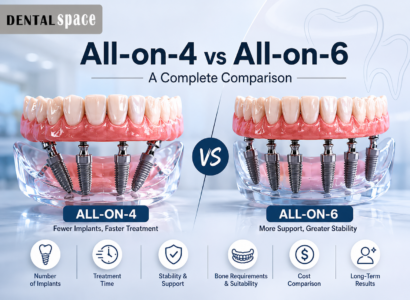
All-on-4 is a full-arch restoration technique that replaces an entire row of teeth — upper or lower — using just four strategically placed implants. Two implants go in vertically at the front of the jaw, and two are angled at roughly 45 degrees toward the back. That angulation is clever engineering: it allows the posterior implants to reach denser, more stable bone without needing bone grafting in most cases.
The result? A full set of fixed teeth, often placed within a single day. This is what the industry calls “teeth in a day” — and it’s genuinely life-changing for patients who’ve been wearing removable dentures.
What makes All-on-4 particularly appealing is its accessibility. Because fewer implants are used and bone grafting is often avoided, the cost of full mouth dental implants with this method is significantly lower than traditional implant approaches. For many patients, it’s the first time a permanent, fixed solution actually feels financially realistic.
What Are All-on-6 Dental Implants?
All-on-6 follows the same principle — a full arch of prosthetic teeth supported by implants — but uses six implants instead of four. The two additional implants are typically placed in the premolar region, distributing the biting load more evenly across the jaw.
Here’s where things get interesting: that extra support isn’t just about redundancy. It changes the biomechanics of how force is distributed when you chew. With six anchor points, the prosthetic arch is more stable, particularly in the upper jaw where bone is naturally less dense than the lower jaw. This matters enormously for patients who have a stronger bite, those who grind their teeth, or those who’ve experienced some degree of bone loss.
If All-on-4 is the well-engineered compact option, All-on-6 is the reinforced version built for added long-term confidence.
All-on-4 vs All-on-6: The Key Differences
Bone Requirements
This is often the deciding factor. All-on-4 implants were specifically designed to work with less bone volume, making them ideal for patients who have experienced jaw bone loss — a common consequence of prolonged tooth loss. The angled placement of the posterior implants sidesteps areas where bone has deteriorated.
All-on-6, on the other hand, requires slightly more bone volume to accommodate the additional implants. However, if you have adequate bone density, the six-implant system provides a more distributed foundation — which pays dividends over years of use.
Stability and Load Distribution
With four implants supporting a full arch of 10–12 teeth, each implant bears a relatively higher load. All-on-4 dental implants are well-engineered to handle this, but All-on-6 spreads that force across two extra anchor points. For patients who are heavy chewers or who have a history of bruxism (teeth grinding), this additional stability can make a meaningful difference in the longevity of the prosthesis.
Treatment Complexity and Timeline
Both procedures can often be completed with teeth placed on the same day as surgery. However, All-on-6 is inherently a more complex surgery — more implant sites, more precision required, and slightly longer healing considerations. In our experience, patients with good bone health tolerate both procedures well, but the surgeon’s skill and planning are critical regardless of which route you take.
Cost of Full Mouth Dental Implants
Let’s address this directly, because it’s usually the first question people ask. All-on-4 dental implants are generally less expensive than All-on-6 — primarily because fewer implants and less surgical complexity are involved. In India, and particularly in Mumbai, the cost of full mouth dental implants with the All-on-4 method can be a fraction of what the same procedure costs in the UK, US, or Singapore, without any compromise in clinical quality.
All-on-6 costs more, but it’s not simply “more expensive for no reason.” The additional cost often correlates with greater long-term stability, particularly for patients whose anatomy or bite demands it. The right question isn’t “which is cheaper?” — it’s “which gives me the best value over the next 20 years?”
Who Is the Right Candidate for Each?
Consider All-on-4 if you:
- Have experienced significant bone loss and want to avoid bone grafting
- Are looking for a cost-effective, proven full-mouth solution
- Want a faster treatment journey with minimal surgical intervention
- Have adequate bone density at the front of the jaw
Consider All-on-6 if you:
- Have good overall bone volume across the jaw
- Have a strong bite or a history of grinding
- Want maximum long-term stability and load distribution
- Are replacing teeth in the upper jaw, where bone density is naturally lower
It’s worth noting that neither option is universally “better.” The right choice depends entirely on your individual anatomy, oral health history, and what you need from your new smile. This is exactly why a thorough clinical assessment — including 3D CBCT imaging — is non-negotiable before any implant plan is finalised.
What About the Prosthesis Itself?
One thing patients often overlook is that both All-on-4 and All-on-6 use the same types of prosthetic arches — typically made from high-quality acrylic, zirconia, or a hybrid material. The prosthesis quality, the number of teeth, and the aesthetics of the final result are largely independent of whether four or six implants were placed underneath.
What this means practically: the visible, functional outcome of both procedures can look and feel remarkably similar. The difference lives beneath the gum line — in the structural foundation that supports your smile for decades.
Why Patients Travel to Mumbai for This Treatment
Mumbai has quietly become one of the most sought-after destinations for full-mouth implant treatment, and DentalSpace in Girgaon, South Mumbai, is a testament to why. World-class clinical training, internationally certified implantologists, and transparent pricing have made high-quality dental care genuinely accessible — for local patients and those flying in from abroad.
Dr. Payal Agarwal trained in implant dentistry at the National University of Singapore and brings over two decades of experience to every full-arch case. The clinic uses advanced digital planning and 3D imaging to ensure precision placement — so what you’re paying for in Mumbai isn’t a cut-price service. It’s exceptional care at a fraction of the cost you’d pay elsewhere.
Making Your Decision
All-on-4 and All-on-6 dental implants are both remarkable solutions to a problem — complete tooth loss — that once had far more limited answers. The choice between them isn’t something to make based on a blog alone. But understanding the differences means you walk into your consultation with better questions, a clearer sense of your priorities, and no surprises.
If you’re ready to explore which full-mouth implant solution is right for your case, the team at DentalSpace is happy to walk you through a full clinical assessment, discuss your options honestly, and give you a transparent picture of costs — without pressure, without jargon.
Your smile deserves a foundation built for the long term. Let’s find the right one.