

You’ve been ignoring that tooth for two weeks now. Some days it’s a dull ache, some days it’s sharp enough to stop you mid-bite. You’ve been chewing on the other side, avoiding cold water, and quietly hoping it sorts itself out.
Then your dentist says “root canal”, and suddenly the toothache feels like the easier option.
That reaction is more common than you’d think. Root canals are probably the most feared dental procedure in existence, and yet, almost nobody who’s actually had one , done properly, by the right hands , comes out saying it was as bad as they expected. In fact, most patients at DentalSpace say some version of the same thing after: “That was it? I built this up for nothing.”
So let’s talk about what actually happens. No drama, no sugarcoating, just a clear, honest walkthrough of the root canal procedure steps and a real answer to the question everyone’s actually asking: is a root canal painful?
Why the Tooth Gets to This Point
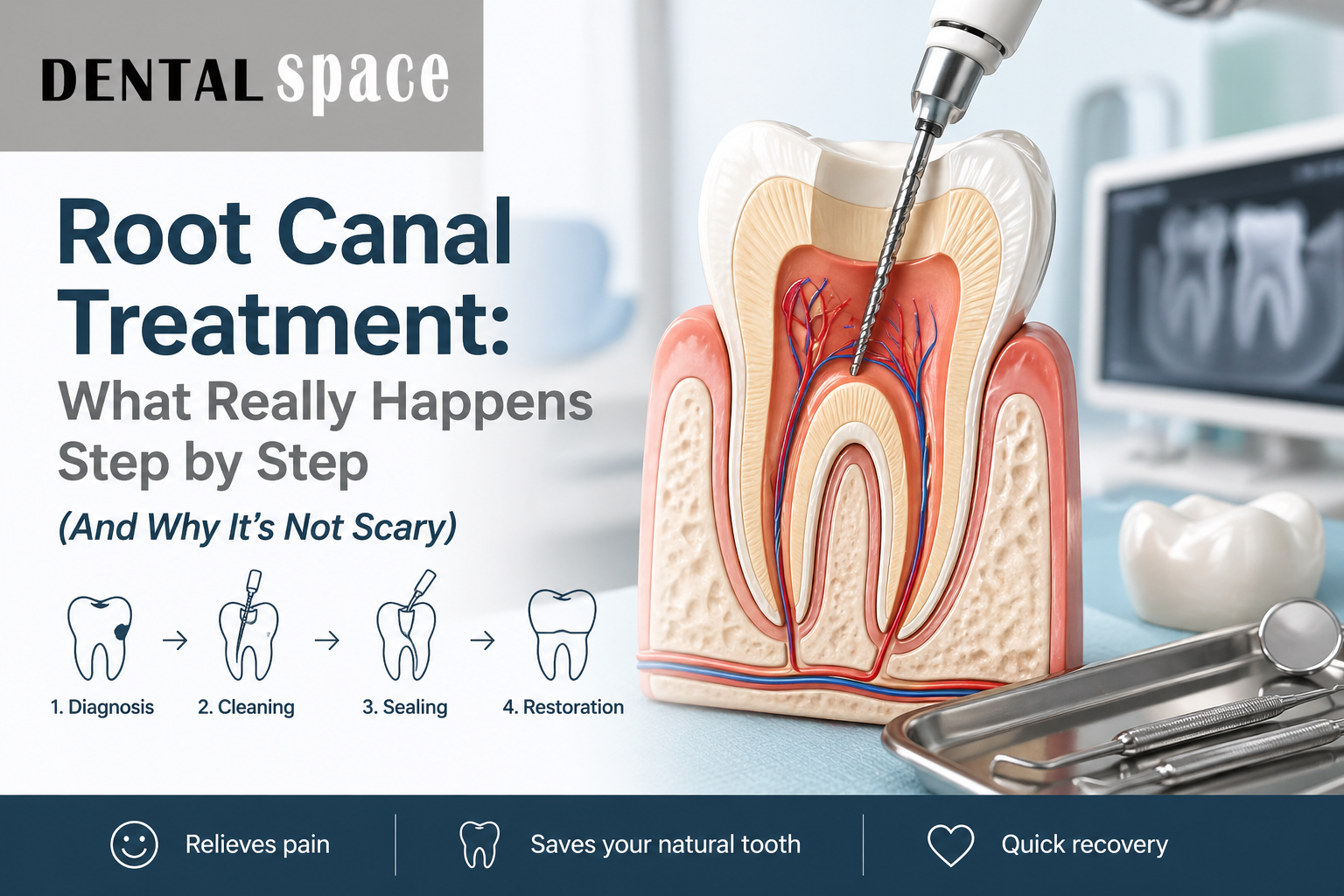
Inside every tooth, beneath the hard enamel, sits a soft layer called the pulp, a mix of nerves, blood vessels, and tissue. When bacteria enter through a deep cavity, a crack, or an old, failing filling, the pulp gets infected. It becomes inflamed. And because it’s trapped inside the rigid walls of a tooth, the pressure builds with nowhere to go.
That’s the pain you’ve been feeling. That’s what’s been waking you up at 2 AM.
Here’s what most people don’t realise at this point: the tooth can still be saved. A root canal doesn’t remove the tooth. It removes the infection from inside it. You keep your natural tooth, your bite stays intact, your jaw stays healthy, and you avoid the far more involved process of extractions and implants down the line.
The procedure exists to save what’s still worth saving. And in most cases, quite a lot is.
The Root Canal Procedure Steps: What’s Actually Happening
Step 1: X-Ray and Examination
Before anything else, your dentist takes a detailed digital X-ray of the tooth. This shows how many canals the tooth has (front teeth usually have one; molars can have three or four), how deep the infection runs, and how the roots are shaped. At DentalSpace, we use advanced digital imaging, clearer, faster, and far less radiation than traditional X-rays.
This step is what allows the rest of the procedure to be precise rather than guesswork.
Step 2: Local Anaesthesia, This Is the Part That Matters Most
Let’s address it directly: Is a root canal painful? The answer, with proper anaesthesia, is no.
A topical numbing gel is applied to the gum first, so you barely feel the injection. Then the local anaesthetic is administered around the tooth. Within a few minutes, the area is completely numb. You may feel pressure or movement during the procedure; that’s normal, but sharp pain is not.
What people actually remember as “root canal pain” is almost always the infected tooth they arrived with, not the treatment itself. The procedure, once you’re numb, is typically no more eventful than a standard filling.
For patients who are particularly anxious, we take extra time here to ensure the anaesthesia has fully taken effect before proceeding. Nobody rushes anything at DentalSpace.
Step 3: Isolation
Isolation is done to prevent debris from reaching the rest of your mouth and makes the whole procedure safer. It takes seconds to place, and most patients forget it’s there.
Step 4: Accessing the Pulp
A small opening is made through the top of the tooth to reach the infected pulp inside. Yes, there’s a drill involved, and yes, you’ll hear it. But because the area is fully numb, what you feel is at most a mild vibration.
A practical tip we always share: if the sound bothers you, put in your earphones. We’ve had patients listen to podcasts, playlists, and audiobooks straight through their root canal. It genuinely helps.
Step 5: Removing the Infected Pulp
rubber
This is the core of the procedure, and where it gets its name. Using fine, flexible instruments, your dentist methodically cleans the infected tissue from inside each canal, working carefully through the full length of the root.
This step takes time. It’s not rushed, because it shouldn’t be. The thoroughness here determines how well the tooth holds up for the next ten, fifteen, or twenty years. At DentalSpace, most root canals are 90% or more than that completed in a single sitting. Patients who come in expecting multiple appointments often leave pleasantly surprised.
Step 6: Disinfection and Irrigation
Once the pulp is removed, the canals are flushed with antimicrobial solutions to eliminate any remaining bacteria. This is one of the quieter steps from the patient’s perspective, but one of the most important clinically. It’s the difference between a root canal that lasts and one that needs to be revisited.
Step 7: Filling the Canals ‘
The cleaned canals are filled with a biocompatible, rubber-like material called gutta-percha, which seals them completely and prevents bacteria from getting back in. The tooth is then sealed at the top with a filling.
At this point, the infection is gone. The canals are sealed. The tooth is saved.
Step 8: The Crown, Completing the Restoration
Most teeth that have had root canal treatment need a crown, usually placed at a follow-up appointment. Without the pulp, the tooth can become more brittle over time, and a crown protects it from fracture while restoring its natural appearance and full biting function.
At DentalSpace, crowns are crafted to look completely natural. Many patients genuinely can’t tell afterwards which tooth was treated, which is exactly the goal.
After the Procedure: What’s Normal
The anaesthesia wears off in a few hours. Some mild soreness around the tooth and gum is normal for a day or two; the tissue has been worked on and needs time to settle. Standard over-the-counter pain relief is usually all that’s needed.
What’s almost universally true is that patients feel considerably better within 24 to 48 hours than they did before the procedure. Because the source of the pain, the infection, has been removed.
Avoid chewing on that side until the permanent crown is in place, continue brushing and flossing everywhere else, and don’t skip the crown appointment. It’s not optional; it’s what protects everything the root canal achieved.
What Happens If You Keep Delaying
Here’s where we’ll be direct, because it matters.
A tooth infection does not resolve on its own. The pain may ebb and flow, giving the impression that things are improving. They’re not. Beneath the surface, the infection continues to progress, spreading to adjacent teeth, into the jawbone, and sometimes beyond. What is currently a single root canal can become an extraction, then an implant, then a significantly more complicated and expensive treatment journey.
Early treatment is almost always simpler treatment. That’s not a sales pitch; it’s just consistently what we observe.
If fear is what’s been keeping you away, that’s something we can work with. But waiting tends to make the clinical situation harder, not easier.
The Honest Summary
Root canals have a reputation that has long since stopped being deserved. Modern anaesthesia, better instruments, and refined techniques have made the procedure genuinely comfortable for the vast majority of patients. The steps of the root canal procedure are logical, methodical, and, with the right team, far less dramatic than the stories suggest.
Is a root canal painful? Not when it’s done well. Not with proper numbing. Not at a clinic where the team treats your anxiety with the same seriousness as your clinical condition.
Dr Payal Agarwal‘s philosophy at DentalSpace has always been simple: dentistry should be done with the highest clinical standards and genuine patient comfort, not one or the other, but both. Every step is explained before it happens. Every concern is taken seriously. And nobody picks up an instrument until you’re ready.
If you’ve been sitting on a tooth that doesn’t feel right, come in. Let us take a look. The problem rarely solves itself, but it almost always responds well when caught early.
Your tooth is probably worth saving. And the procedure to save it is probably far more manageable than you’ve been imagining.
DentalSpace | Girgaon, South Mumbai | Root Canal Treatment, Dental Implants, Smile Design & More
Book a consultation on WhatsApp or call us directly; same-day appointments are available.