

A patient walked in last month holding her phone up to show us a photo from a wedding. Great smile, except for one front tooth with a visible chip from years ago, and a faint yellow line along the edge that the camera flash had picked up perfectly. She wasn’t asking for a smile makeover. She just wanted that one tooth to look like it belonged with the rest of her teeth again.
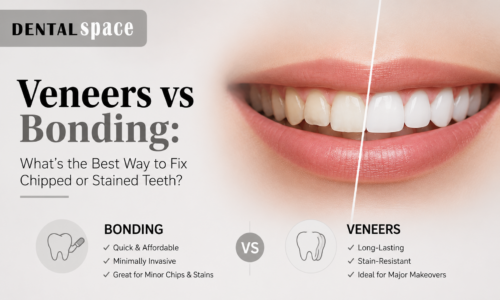
This is the question we get asked almost every week, and it usually comes down to a choice between dental veneers vs bonding. Both can fix chips, gaps, and stains. Both can be done quickly. But they are not interchangeable, and picking the wrong one for your situation either costs you more money later or leaves you mildly disappointed with results that don’t quite hold up.
Here’s a straightforward look at dental veneers vs. bonding: what each does, what they cost in India, and how to know which one fits your teeth and your budget.
What Bonding Actually Does
Bonding is the simpler of the two procedures. We apply a tooth-coloured resin directly onto the damaged area, shape it while it’s still soft, and harden it with a curing light. No lab work, no waiting period, no second appointment. Most chips, small gaps, and minor discolouration can be corrected in a single sitting, often within an hour.
What most people don’t realise is that bonding barely touches the natural tooth. There’s little to no enamel removal involved, which makes it a conservative, low-commitment fix. The trade-off is durability. Composite resin can stain over time with tea, coffee, or red wine, and it isn’t as resistant to chipping again as a lab-made veneer would be. On average, bonding holds up well for three to seven years before needing a touch-up or a redo.
What Veneers Actually Do
Veneers take a different approach. A thin shell, either composite or porcelain, is custom-made to cover the entire front surface of the tooth. For porcelain veneers specifically, a small layer of enamel is shaved off first to make room for the shell, and the veneer itself is fabricated in a lab before being permanently bonded in a second visit.
This extra step is exactly why veneers tend to outperform bonding on two fronts: they resist staining far better, and they last considerably longer. Porcelain veneers commonly last 10 to 15 years with proper care, compared to bonding’s much shorter lifespan. They also handle larger cosmetic corrections better, including reshaping a tooth that’s visibly shorter, narrower, or more discoloured than the rest.
Veneers vs Bonding: The Honest Comparison
Here’s where things get interesting once you put cost, durability, and appearance side by side.
| Factor | Dental Bonding | Dental Veneers |
| Best for | Small chips, minor gaps, light staining | Larger chips, deeper stains, reshaping |
| Procedure time | Single visit, same day | Two visits, lab fabrication in between |
| Enamel removal | Minimal to none | Some removal (porcelain), minimal (composite) |
| Stain resistance | Lower can discolour over time | High, especially porcelain |
| Typical lifespan | 3 to 7 years | 5 to 7 years (composite), 10 to 15 years (porcelain) |
| Reversibility | Mostly reversible | Less reversible, especially porcelain |
Neither option is universally “better.” When patients ask us to settle dental veneers vs. bonding once and for all, the honest answer is that it depends on the tooth. A single, small chip on a molar doesn’t need a veneer. A front tooth that’s visibly stained, slightly uneven, and constantly on camera might be a poor long-term candidate for bonding alone.
Dental Bonding Cost in India: What to Expect
This is usually the deciding factor for many patients, and it’s a fair one. The cost of dental bonding in India typically ranges from ₹2,000 to ₹6,000 per tooth, depending on the extent of the damage and the clinic. Because it’s done chairside in a single visit with no lab fees, it remains one of the most affordable cosmetic fixes available.
If you’re correcting just one or two teeth and the issue is minor, bonding often makes financial sense as a first step, with the option to upgrade to veneers later if needed.
Dental Veneers India: What the Investment Looks Like
Dental veneers India pricing varies more, since the material plays a big role. Composite veneers generally range from ₹5,000 to ₹20,000 per tooth, while porcelain veneers, the more durable and stain-resistant option, typically run between ₹12,000 and ₹30,000 per tooth in a metro city like Mumbai. A full smile makeover involving several veneers will naturally scale up from there, but even at the higher end, it remains a fraction of what the same porcelain veneers would cost in the UK, USA, or Australia.
It’s a bigger upfront investment than bonding, but when you divide that cost over a 10- to 15-year lifespan, the per-year value often works out to be close to, or better than, repeated bonding touch-ups.
So, Which One Actually Fixes Your Tooth Better?
If the damage is small, recent, and limited to one or two spots, bonding is usually the right call. It’s fast, affordable, and barely invasive. If the chip is older, the stain runs deeper than the enamel, or you’re dealing with a tooth that’s visibly different in shape or size from its neighbours, veneers tend to deliver a result that actually lasts.
The honest answer, and one we’ll always give you directly, is that it depends on what we see in your mouth, not on what sounds more impressive. We’ve turned down veneer requests when bonding would have done the job just as well, because the goal here isn’t the bigger bill. It’s a better fit for your tooth.
How We Approach This at DentalSpace
We walk every patient through this decision step by step before any treatment begins. You’ll see exactly what bonding or veneers would look like on your specific tooth, what it will cost upfront with no hidden additions later, and why we’re recommending one over the other. Using Philips Zoom whitening and porcelain veneer techniques, along with detailed shade-matching, the goal is always a result that looks like your tooth, not a noticeably “done” one.
If that chipped or stained tooth has been sitting in the back of your mind, it’s worth a quick consultation to see which fix actually makes sense for you, rather than guessing based on what worked for someone else’s smile.